Most Famous Graves in Berlin: A Guide to the City's Most Fascinating Final Resting Places
Berlin is a city shaped by history, and few places tell its story better than its historic cemeteries. From Nobel Prize winners and world-famous artists to political leaders, philosophers and revolutionaries, Berlin's graveyards are open-air museums where visitors can explore more than 300 years of history.
Many of these cemeteries are beautiful parks in their own right, offering peaceful walks away from the crowds while revealing remarkable biographies that shaped Germany and the world.
As a professional historian and licensed Berlin guide, I also organize private cemetery tours for individuals and small groups, combining fascinating stories with visits to some of Berlin's most beautiful historic cemeteries. If you're interested in history beyond the typical tourist attractions, a cemetery tour is one of the city's hidden gems.
Marlene Dietrich
Perhaps no grave attracts more international visitors than that of Marlene Dietrich (1901–1992). Born in Berlin-Schöneberg, she became one of Hollywood's greatest stars after appearing in The Blue Angel. During the Nazi era she refused to support Hitler, emigrated to the United States, entertained Allied troops during World War II, and later spent much of her life in Paris.
Although she never permanently returned to Germany, she requested to be buried in her hometown. Her simple grave is often decorated with flowers, letters and lipstick kisses left by admirers from around the world.
Where: Stubenrauch Cemetery, Friedenau

Willy Brandt
The grave of Willy Brandt (1913–1992) is one of Germany's most significant political memorials. Brandt served as Governing Mayor of West Berlin during the construction of the Berlin Wall before becoming Chancellor of West Germany and receiving the Nobel Peace Prize for his groundbreaking Ostpolitik.
His burial place is located in the peaceful Waldfriedhof Zehlendorf, where several other prominent German politicians are buried, including Ernst Reuter, Walter Scheel and Otto Suhr.
Where: Waldfriedhof Zehlendorf
The Brothers Grimm
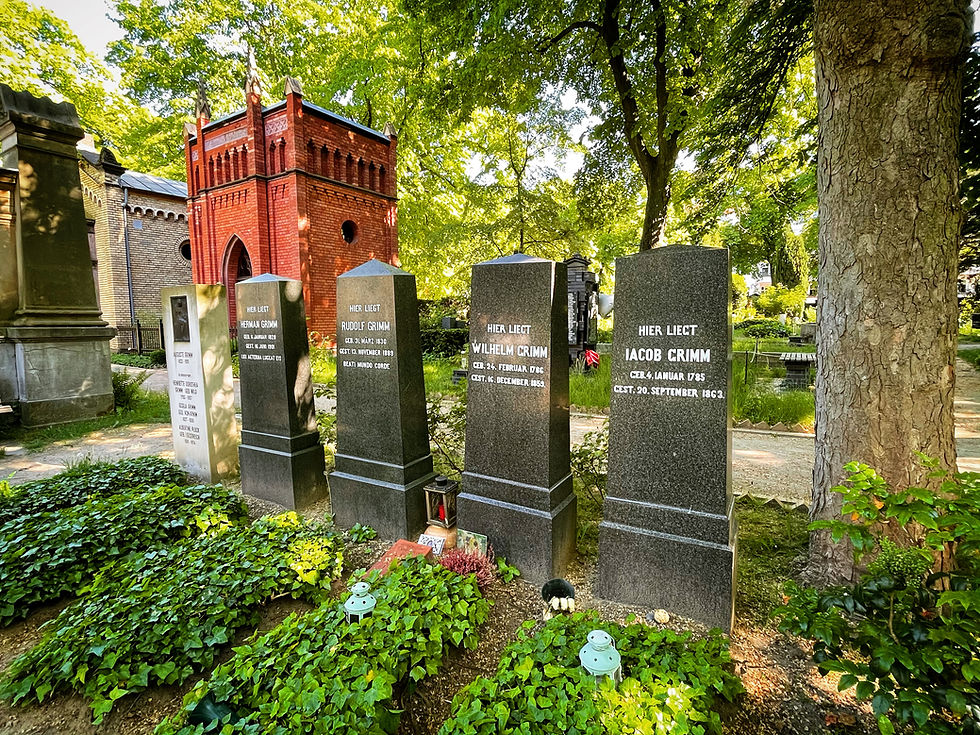
Jacob and Wilhelm Grimm are among the world's best-known storytellers. Their collection of more than 200 fairy tales introduced classics such as Snow White, Sleeping Beauty and Hansel and Gretel to generations of readers.
Both brothers spent their final years in Berlin working on the monumental German Dictionary. Their shared grave at Alter St. Matthäus Cemetery remains one of the city's most visited literary memorials.
Where: Alter St. Matthäus-Kirchhof
Frederick the Great
Just outside Berlin, visitors can pay their respects to Frederick the Great, the famous King of Prussia.
Rather than being buried inside a church or royal crypt, Frederick rests on the vineyard terrace of Sanssouci Palace, exactly where he wished. Visitors continue the unusual tradition of leaving potatoes on his grave, commemorating his role in promoting potato cultivation throughout Prussia.
Where: Sanssouci Palace, Potsdam

Georg Wilhelm Friedrich Hegel
The philosopher Georg Wilhelm Friedrich Hegel (1770–1831) taught at Berlin University and became one of the founders of modern philosophy. His ideas profoundly influenced thinkers ranging from Karl Marx to Søren Kierkegaard.
Hegel's grave can also be found in Dorotheenstadt Cemetery, only a short walk from Bertolt Brecht's final resting place.
Where: Dorotheenstadt Cemetery
Rosa Luxemburg and Karl Liebknecht
The Memorial to the Socialists at Friedrichsfelde Cemetery remains one of Berlin's most politically significant burial sites.
Here lie Rosa Luxemburg and Karl Liebknecht, founders of the German Communist Party, who were murdered following the Spartacist Uprising in January 1919. Their graves became places of pilgrimage throughout the twentieth century, particularly during the East German period.
The memorial also contains the graves of several leading figures of the former German Democratic Republic, including Walter Ulbricht, Wilhelm Pieck and Otto Grotewohl.
Where: Zentralfriedhof Friedrichsfelde
Alexander von Humboldt
Explorer, geographer and natural scientist Alexander von Humboldt (1769–1859) ranks among history's greatest explorers.
His expeditions through Latin America inspired scientists including Charles Darwin. Humboldt is buried in the family cemetery beside Tegel Palace, where he spent much of his life.
Where: Family Cemetery at Schloss Tegel

The Siemens Family Mausoleum
One of Germany's most impressive mausoleums belongs to the Siemens family, founders of the industrial giant Siemens.
Located in the magnificent Südwestkirchhof Stahnsdorf just outside Berlin, the elaborate family tomb reflects both the wealth and influence of one of Germany's greatest industrial dynasties. The cemetery itself is widely regarded as one of the most beautiful in Europe.
Where: Südwestkirchhof Stahnsdorf
Bertolt Brecht and Helene Weigel
The Dorotheenstadt Cemetery is arguably Berlin's most famous cemetery. Its best-known grave belongs to playwright Bertolt Brecht (1898–1956), one of the most influential theatre writers of the twentieth century.
Beside him lies his wife, actress Helene Weigel, who directed the Berliner Ensemble after his death. Walking through the cemetery feels like strolling through German cultural history, with nearby graves including novelist Heinrich Mann, playwright Heiner Müller and writer Christa Wolf.
Where: Dorotheenstadt Cemetery

Felix Mendelssohn Bartholdy
Composer Felix Mendelssohn Bartholdy (1809–1847) rests in the family grave at the Dreifaltigkeit Cemetery in Kreuzberg.
Although born in Hamburg and dying in Leipzig, Berlin played an important role in his career. The surrounding cemetery also contains graves of famous Romantic writers including E.T.A. Hoffmann and Adelbert von Chamisso.
Where: Friedhof I der Dreifaltigkeitsgemeinde, Kreuzberg
Moses Mendelssohn
The oldest surviving Jewish cemetery in central Berlin contains the grave of philosopher Moses Mendelssohn (1729–1786), one of the leading figures of the Jewish Enlightenment.
The cemetery itself has a tragic history. It was badly damaged during the Nazi era, and today only fragments remain, making it one of Berlin's most moving historical sites.
Where: Jewish Cemetery, Große Hamburger Straße
Max Liebermann
One of Germany's greatest Impressionist painters, Max Liebermann (1847–1935) helped shape modern German art. A Berlin native, he became president of the Prussian Academy of Arts and was one of the country's most celebrated artists before the Nazis forced him from public life because of his Jewish heritage.
Liebermann spent his final years largely isolated in his home on Pariser Platz, overlooking the Brandenburg Gate. According to family tradition, he watched Nazi torchlight processions pass beneath his window and remarked, "I cannot possibly eat as much as I would like to vomit." He died in 1935, and because of growing antisemitism, only a small group attended his funeral.
His grave lies in the Jewish Cemetery on Schönhauser Allee, one of Berlin's oldest surviving Jewish cemeteries. It remains a place of remembrance not only for Liebermann himself but also for Berlin's once-thriving Jewish cultural life.
Where: Jewish Cemetery Schönhauser Allee, Prenzlauer Berg
Rudolf Virchow
Known as the father of modern pathology, Rudolf Virchow (1821–1902) revolutionized medicine by demonstrating that diseases originate in cells.
Beyond medicine, he was also a politician, anthropologist and outspoken critic of Otto von Bismarck. His grave can be found in the same cemetery as the Brothers Grimm.
Where: Alter St. Matthäus-Kirchhof
Nico
Singer, model and actress Nico (Christa Päffgen) became internationally famous through her collaboration with The Velvet Underground.
Her grave lies in the secluded Grunewald Forest Cemetery, once known as Berlin's "Suicide Cemetery" because it was originally established for people denied burial elsewhere. Hidden among the trees, it remains one of Berlin's most atmospheric cemeteries.
Where: Friedhof Grunewald-Forst
Princess Victoria
The Church of Peace (Friedenskirche) in Sanssouci Park contains the tomb of Princess Victoria, the eldest daughter of Queen Victoria of Great Britain and wife of the future German Emperor Frederick III.
Known for her liberal political views and close ties to Britain, Victoria played an important role in nineteenth-century European history. The church itself is one of Potsdam's architectural masterpieces.
Where: Church of Peace, Sanssouci Park
Explore Berlin's Cemeteries with a Private Guide
Berlin's cemeteries offer far more than famous graves. They tell stories of artists, scientists, philosophers, musicians, politicians, Holocaust survivors and ordinary Berliners whose lives shaped the city.
If you would like to discover these remarkable places in greater depth, I offer private cemetery tours for individuals, couples and small groups. Each tour can be tailored to your interests, whether you are fascinated by Prussian history, the Third Reich, Cold War Berlin, Jewish history, literature, music or famous Berlin personalities.
A guided cemetery walk combines history, architecture, art and biography while visiting some of Berlin's quietest and most beautiful green spaces—places that many visitors never discover.


Comments