Berlin & Potsdam Attractions Under Renovation (Updated Regularly)
Berlin and Potsdam are two of Europe's most fascinating historic destinations. Unfortunately, they are also cities where restoration projects, museum closures and construction work are a constant reality. Nothing is more frustrating than arriving at a famous landmark only to discover it is hidden behind scaffolding, partly inaccessible, or completely closed for renovation.
This regularly updated guide tracks the most important attractions, museums, palaces and historic sites currently under renovation in Berlin and Potsdam. Whether you are planning your first visit or returning to explore more of the city, this page will help you avoid disappointment, adjust your itinerary and discover alternative sights nearby.
Pergamon Museum
The world-famous Pergamon Museum on Berlin’s Museum Island has been closed since October 2023 for one of the largest museum renovation projects in Europe. The building is undergoing extensive structural repairs, modernization work and restoration of its exhibition halls. The good news for visitors is that large parts of the museum — including the famous Pergamon Altar, the Museum of Islamic Art and major sections of the Classical Antiquities Collection — are scheduled to reopen on 4 June 2027. However, the renovation is being carried out in phases. Some of the museum’s most iconic exhibits, including Babylon’s Ishtar Gate and the Processional Way, remain in the southern wing, which is expected to stay closed until 2037. Visitors planning a trip before June 2027 should be aware that the museum remains completely inaccessible, although the nearby exhibition Pergamon. Das Panorama offers an alternative glimpse into the ancient world.

German History Museum
Visitors hoping to explore Germany’s national history museum should be aware that the historic Zeughaus, the main building of the Deutsches Historisches Museum on Unter den Linden, remains closed due to a major modernization and renovation project. Originally expected to reopen in 2025, the project has suffered significant delays, and construction work is still in the planning phase. Current estimates suggest that a reopening of the Zeughaus and its new permanent exhibition is unlikely before 2031, although no binding completion date has yet been confirmed by the responsible federal authorities. The museum's modern Pei Building remains open with temporary exhibitions, but the famous permanent exhibition on German history is not accessible until the renovation is completed.
Märkisches Museum (Future Berlin Museum)
Berlin’s historic Märkisches Museum, long the city’s main museum dedicated to Berlin’s history, has been closed since January 2023 for a comprehensive renovation and transformation project. Together with the neighboring Marinehaus, it will become the centerpiece of a completely reimagined museum complex focusing on Berlin’s past, present and future. The project is increasingly being presented as a new city history museum for the capital, replacing the traditional concept of the Märkisches Museum with a broader and more modern interpretation of Berlin’s story. Construction delays have pushed back the original timetable, and current expectations point to a reopening around 2028 rather than the earlier target dates. Until then, visitors interested in Berlin’s history can find parts of the Stadtmuseum Berlin collection at the Humboldt Forum and other museum locations across the city.
Natural History Museum
Berlin’s beloved Museum für Naturkunde, home to the world-famous dinosaur skeletons and one of Germany’s largest natural history collections, is in the middle of a long-term transformation into a modern science campus. Unlike the Pergamon Museum or Märkisches Museum, the museum remains open to visitors during most of the construction work, but guests should expect occasional building works, temporary closures of individual areas and construction activity around the site. The project includes the renovation of historic buildings, new exhibition spaces, upgraded visitor facilities and major expansion of research and collection infrastructure. The overall investment amounts to around €660 million, making it one of Berlin’s largest cultural construction projects. The transformation will be carried out in stages over many years, with major elements of the new campus expected to be completed during the early to mid-2030s, meaning visitors can still enjoy the museum today while parts of its future are literally being built around them.

Bauhaus-Archiv
Fans of architecture and design will have to wait a little longer for the return of one of Berlin’s most important museums. The Bauhaus-Archiv / Museum für Gestaltung in Tiergarten has been closed since 2018 for a major renovation and expansion project that includes the restoration of Walter Gropius’ iconic museum building, a new underground exhibition wing, modern visitor facilities and additional collection space. The project has experienced several delays over the years, but construction is now well advanced, with the first completed museum spaces presented to the public in 2026. According to the latest timetable, the museum is now expected to reopen in winter 2027/28, making it one of Berlin’s longest-running cultural construction projects. Until then, visitors can explore exhibitions and events at the temporary Bauhaus-Archiv location in Charlottenburg.
Komische Oper Berlin
One of Berlin’s most important cultural institutions remains hidden behind construction fences. The Komische Oper on Behrenstraße has been closed since 2023 for a comprehensive renovation, modernization and expansion project that will restore the historic opera house while adding a striking new extension with rehearsal spaces, visitor facilities, educational areas, offices, a café and a rooftop terrace. Although much of the work currently takes place behind the scenes, the project has become increasingly expensive and is now expected to cost close to €500 million. While the construction itself continues, the timeline has slipped considerably. The opera company is currently performing at the Schillertheater in Charlottenburg, and management has indicated that a return to the historic home is now unlikely before 2032–2033. Visitors walking past the site today will therefore see a major construction project that is likely to remain part of Berlin’s cityscape for the rest of the decade.
Schloss Cecilienhof
One of Potsdam’s most important historic landmarks, Schloss Cecilienhof, closed in November 2024 for a comprehensive restoration project. The work focuses on preserving the UNESCO World Heritage site’s historic interiors, upgrading building services and improving visitor infrastructure. The palace is best known as the venue of the Potsdam Conference of 1945, where Truman, Stalin and Churchill shaped post-war Europe. According to the current schedule, the renovation is expected to continue until 2027, meaning visitors will not be able to enter the palace or see the famous conference rooms until then. While the building itself remains closed, the surrounding Neuer Garten park remains accessible and is still well worth a visit.

Neues Palais
Visitors to Potsdam’s magnificent Neues Palais in Sanssouci Park will encounter a number of construction projects over the coming years. Since 2025, extensive restoration work has been underway both inside and outside Frederick the Great’s largest palace. The projects include façade repairs, roof restoration, conservation of historic interiors, modernization of technical infrastructure and work on the famous Communs buildings opposite the palace. Unlike some other major attractions, the palace remains partially open during much of the renovation period, although individual rooms, sections and visitor routes may be temporarily inaccessible. The restoration program is being carried out in phases and is expected to continue until at least 2028, meaning visitors should expect occasional scaffolding and restricted access while one of Potsdam’s most important UNESCO World Heritage sites is preserved for future generations.
Römische Bäder
One of the hidden architectural gems of Sanssouci Park is currently closed for a comprehensive restoration project. The picturesque Römische Bäder (Roman Baths) ensemble, designed by Karl Friedrich Schinkel and Ludwig Persius between 1829 and 1841, has suffered extensive damage from moisture, frost and decades of weather exposure. Restoration work includes repairs to the historic buildings, walls and garden structures, stabilization of roofs and masonry, restoration of interior wall paintings and artworks, and improvements to the surrounding landscape. Construction began in 2024, and despite major progress already being visible, visitors should not expect access anytime soon. According to the Stiftung Preußische Schlösser und Gärten, the UNESCO-listed complex is scheduled to reopen in 2029, making this one of Potsdam’s longest-running heritage restoration projects.
Orangerieschloss
Visitors to Potsdam’s spectacular Orangerieschloss in Sanssouci Park should be prepared for scaffolding and construction work for several years. The palace, one of the largest and most impressive buildings in the UNESCO World Heritage park, is undergoing a comprehensive restoration of its façades, terraces, roofs and historic architectural elements. The project is being carried out in phases to preserve the mid-19th-century palace while keeping parts of the site accessible to visitors. According to the current plans of the Stiftung Preußische Schlösser und Gärten, work is expected to continue until approximately 2029, meaning scaffolding will remain a familiar sight around sections of the palace for much of the decade. While the palace itself remains open, photographers hoping for unobstructed views of one of Potsdam’s most beautiful landmarks may be disappointed for the next few years.

Brandenburger Straße
Visitors strolling along Potsdam’s elegant Brandenburger Straße, the city’s main shopping and pedestrian street, should expect construction work for several more years. The city is carrying out a comprehensive renewal of the historic street, replacing underground utilities, upgrading drainage systems, improving paving and modernizing public infrastructure. Work is being completed in several phases to keep shops, cafés and restaurants accessible throughout the project. Following the completion of earlier sections, the next major construction phase between Dortustraße and Lindenstraße is scheduled to begin in 2026, with further stages to follow afterward. While the street remains open and fully visitable, pedestrians will encounter temporary barriers, construction zones and detours in certain areas. The overall modernization of Potsdam’s most famous shopping street is expected to continue into the late 2020s, with individual sections reopening as work progresses.
Brauhausberg Campus & the “Kreml” Ruins
One of Potsdam’s most prominent eyesores is finally set for a new future. The abandoned former Brandenburg State Parliament building on the Brauhausberg—known to many locals as the “Kreml” because it housed the regional SED leadership during the GDR era—has stood empty and increasingly derelict since 2013. Following years of failed redevelopment plans, vandalism and a devastating fire in 2023, the site is now being transformed into a major new campus for the University of Potsdam with support from the Hasso Plattner Foundation. Planning officially accelerated in 2026, and the project will eventually accommodate thousands of students while expanding Potsdam’s role in research and artificial intelligence. Visitors to Potsdam can expect construction activity around the hilltop site for many years. The redevelopment is planned in phases, with the first visible campus buildings expected toward the late 2020s, while the full university campus is scheduled for completion by 2035.
Kaiser-Wilhelm-Gedächtniskirche
One of Berlin’s most recognizable landmarks is about to undergo its most extensive renovation in decades. Beginning in September 2026, the historic ruined tower will close to visitors, followed by the modern church building and bell tower designed by architect Egon Eiermann. The project addresses serious structural issues, including deteriorating concrete honeycomb elements, aging blue stained-glass windows, outdated heating and water systems, and other technical infrastructure. The famous ruined tower will also receive a completely redesigned exhibition and is expected to become accessible to visitors for the first time in many years. According to current plans, the main renovation phase will last roughly two years, with the tower reopening around 2028/29 and the modern church complex expected to be fully restored by 2029. During this period, parts of the landmark will be inaccessible or surrounded by construction works, although selected church services and events may continue where possible.

Schloss Bellevue
Visitors hoping to see the official residence of Germany’s president should note that Schloss Bellevue closed in 2026 for a comprehensive modernization and restoration project expected to last around eight years. The renovation affects not only the historic palace itself but also the neighboring Federal Presidential Office and parts of the surrounding grounds. Work includes repairing the leaking roof, restoring the façade, replacing outdated technical systems, improving energy efficiency, upgrading security and accessibility, and modernizing fire protection systems. During the construction period, the Federal President has moved to a temporary headquarters in Berlin-Moabit. Current plans suggest that Bellevue will remain closed until approximately 2034, making it one of the longest-running public building renovations in Berlin. Visitors can still view the palace from outside the park perimeter, but tours and official public events at the historic residence are suspended for the duration of the works.
Checkpoint Charlie
Berlin’s famous Checkpoint Charlie is not currently a construction site, but major changes are on the horizon. In September 2026, the city selected the winning design for a new education and memorial center that aims to transform the former Cold War border crossing from a crowded tourist hotspot into a more dignified place of learning and remembrance. Plans include a redesigned public square, exhibition spaces, educational facilities and improved historical interpretation, while retaining key elements such as the iconic checkpoint guardhouse. The project is still in its planning phase, meaning visitors today will largely see the familiar site. However, construction work is expected to begin in the coming years, and the completed memorial complex is unlikely to open before the early 2030s. During the redevelopment, parts of the area may be affected by construction activity, but the historic location itself will remain accessible.

Humboldt Forum & Schlossplatz
The area around Berlin’s reconstructed royal palace remains very much a work in progress. Most notably, the long-delayed Freiheits- und Einheitsdenkmal—better known as the “Einheitswippe” (Unity Seesaw)—remains unfinished after contractor insolvencies and years of delays. While construction has resumed, the monument is currently not expected to open before 2027 at the earliest. At the same time, the city is redesigning large parts of the surrounding Schlossplatz, adding new trees, seating areas and landscaping to create a greener and more welcoming public space. Work has also begun on a new riverside staircase connecting the Humboldt Forum more directly to the Spree. None of these projects affect access to the Humboldt Forum itself, which remains fully open, but visitors should expect construction activity, temporary barriers and an evolving appearance around one of Berlin’s most important cultural landmarks for the next several years.
Neptunbrunnen
Visitors to Berlin’s historic center should be aware that the famous Neptunbrunnen in front of the Red Town Hall is currently hidden behind scaffolding as part of a major restoration project. The beloved fountain, originally created by Reinhold Begas in the late 19th century, is undergoing repairs to its basin, waterproofing, stonework and fountain technology, while the bronze sculptures are being cleaned and conserved. The project is intended to secure the monument’s future after decades of wear and tear. According to the current schedule, the restoration is expected to be completed by the end of 2026, meaning visitors throughout much of 2026 will likely find one of Berlin’s most photogenic landmarks partially or completely obscured by construction works.

Molkenmarkt & Berlin’s Historic Old Town Reconstruction
The Molkenmarkt, Berlin’s oldest square and the birthplace of the medieval city, is currently one of the largest urban redevelopment projects in Germany. For decades the area was dominated by wide roads and post-war planning, but the city is now rebuilding an entire historic neighborhood between the Red Town Hall, the Klosterviertel and the Spree. Visitors will encounter construction sites, archaeological excavations, roadworks and empty building plots as new streets, squares, homes and businesses gradually take shape. In 2026, key architectural and planning decisions were made for the first building plots, marking the beginning of the area's visible transformation. The redevelopment will be carried out in phases over many years, with the first buildings expected to be completed around 2028–2030, while the full reconstruction of the neighborhood will likely continue well into the 2030s. For now, visitors should think of the Molkenmarkt not as a tourist attraction but as a rare opportunity to witness the rebirth of Berlin’s historic center in real time.
Reichstag: Construction Site, Security Trench and Temporary Visitor Facilities
The Reichstag itself remains open to visitors, and tours of the dome and roof terrace continue as normal with advance registration. However, many visitors are surprised by the large number of fences, temporary container buildings and construction areas surrounding Germany’s parliament. These are part of a long-running project to improve security and create a permanent visitor center. A large security trench ("Aha-Graben") and new protective barriers are being built in front of the historic building, while the temporary container facilities that have welcomed visitors since 2011 are gradually being replaced. The original plans have suffered years of delays, redesigns and budget disputes. Current projections suggest that the new visitor center will not be completed before 2032, with handover potentially occurring in 2033, meaning construction work and temporary facilities are likely to remain part of the Reichstag experience for several more years. The good news is that the building itself, the dome and parliamentary visits remain accessible throughout the project.

Bundeskanzleramt Expansion
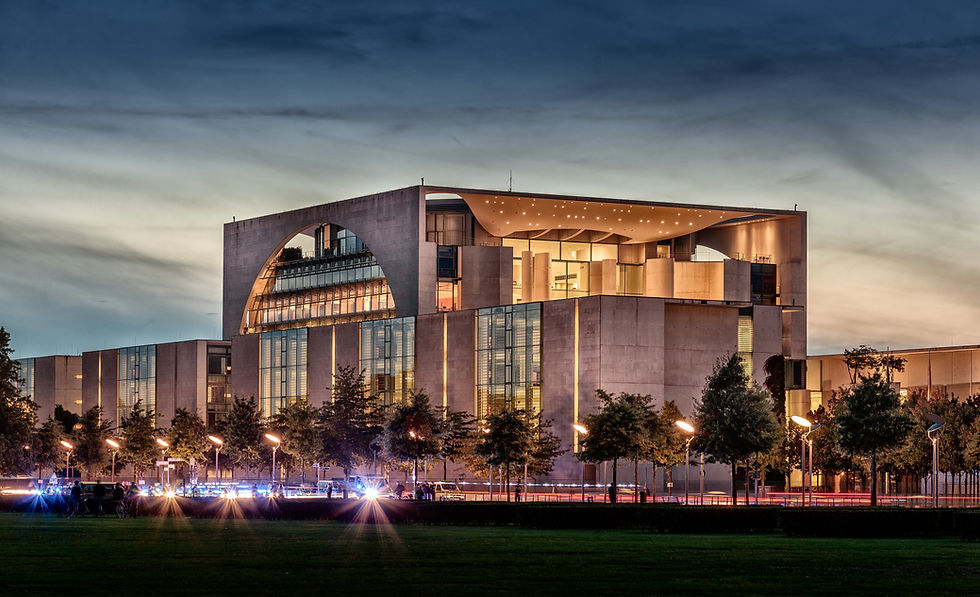
While the Federal Chancellery itself remains fully operational and open for occasional public events, visitors walking through Berlin’s government district cannot miss the enormous construction site on the western side of the Spree. Since 2023, work has been underway on the long-planned expansion of the Bundeskanzleramt, a project that will nearly double the size of the chancellery complex with new office space, conference facilities, security infrastructure, a daycare center and additional support buildings. The massive construction site forms part of the completion of the architectural "Band des Bundes" that stretches through the government quarter. The structural shell is already largely complete, but construction cranes, barriers and heavy building activity will remain visible for several more years. According to the Federal Office for Building and Regional Planning, completion is currently planned for 2028, meaning visitors to the Reichstag and government district should expect this prominent riverside construction site to remain part of the skyline until at least then.
Luisenblock Ost
Visitors walking through Berlin’s government district may notice a vast undeveloped area along the Spree opposite the Marie-Elisabeth-Lüders-Haus. This is the site of Luisenblock Ost, a long-planned expansion of the Bundestag. In 2026, however, the Bundestag’s Building and Space Commission voted to abandon the second phase of the project, which would have included additional parliamentary facilities alongside housing, shops and other uses. The decision was driven by cost concerns and a reduced demand for office space following electoral reforms that shrank the size of the Bundestag. The first phase—containing new parliamentary offices and secure conference facilities—will still go ahead, but the larger original vision has been significantly scaled back. As a result, visitors should expect parts of the area to remain a construction site for years to come, while the future development of the remaining plots is reconsidered.
Schinkelsche Bauakademie
One of Berlin’s most anticipated reconstruction projects is finally moving closer to reality. The Schinkelsche Bauakademie, regarded as one of the most influential buildings of the 19th century, was heavily damaged during World War II and demolished by the East German government in 1962. After decades of debate, the federal government, the State of Berlin and the Federal Foundation for the Building Academy agreed in 2026 that the new building will feature façades closely based on Karl Friedrich Schinkel’s historic design. An architectural competition is currently being prepared, meaning visitors today will still find an empty construction site next to the Humboldt Forum and Friedrichswerdersche Kirche. Construction has not yet begun, but the stated goal is to complete the new Bauakademie by 2031, the 250th anniversary of Schinkel’s birth. Until then, the site remains one of Berlin’s most prominent “missing landmarks” and a symbol of the city’s ongoing reconstruction of its historic center.
Bahnhof Zoologischer Garten
Few visitors realize that Berlin Zoo Station is itself a major construction site, even though trains continue to operate normally. Since 2015, Deutsche Bahn has been carrying out a comprehensive modernization of the historic station building, repairing decades of structural damage discovered after work began. As a result, travelers will encounter scaffolding, construction barriers, closed sections and ongoing building work inside parts of the station. The project has repeatedly been delayed as additional defects were uncovered in the historic structure. According to current plans, construction is now expected to continue until at least 2032, making it one of Berlin’s longest-running infrastructure projects. The station remains fully operational throughout the works, but visitors arriving via one of Berlin’s most famous railway stations should not expect the finished product for several more years.
Berlin Ostbahnhof
One of Berlin’s busiest railway stations is undergoing a far-reaching modernization that many visitors barely notice at first glance. The project includes the restoration of the historic station hall, replacement of the aging glass roof, repairs to the roof structure, façade renovations, improved lighting and upgrades to the station’s technical infrastructure. While train services continue to operate normally, travelers can expect scaffolding, construction barriers and occasional disruptions in parts of the station. The renovation proved far more complex than originally anticipated, with additional structural issues discovered during construction. Current plans foresee the final completion of all works in 2028, by which time Deutsche Bahn will have invested around €120 million in the transformation of the station. Until then, Berlin Ostbahnhof remains fully operational but very much a work in progress.
Bahnhof Alexanderplatz
The station beneath Berlin’s most famous square is about to undergo one of the largest railway renovation projects in the city center. Beginning in 2026, Deutsche Bahn is carrying out a complete modernization of the station’s ground-floor level, including new building services, upgraded fire protection systems, improved accessibility and a comprehensive refurbishment of public areas. To make this possible, the entire ground floor is being stripped back to its structural shell, forcing all shops, restaurants and service businesses to close and move out. While the station will remain fully operational for S-Bahn, regional trains and U-Bahn connections, visitors can expect a much emptier and more construction-dominated environment than in previous years. According to current plans, the project will continue until mid-2029, meaning Alexanderplatz visitors should expect construction barriers and reduced amenities for several years, even though train services themselves will continue largely unaffected.

Europaplatz (Berlin Hauptbahnhof)
Visitors arriving at Berlin’s Central Station will notice that the Europaplatz on the northern side of the station is currently being transformed into a greener, more pedestrian-friendly gateway to the capital. The redesign includes new seating and waiting areas, wider and fully accessible pedestrian routes between the station and public transport stops, a modernized bus stop, space for around 220 bicycles, and the planting of 30 new climate-resilient trees. The goal is to replace the often chaotic and windswept forecourt with a more attractive public space that can better handle the station’s millions of annual visitors. Construction began in February 2026 and is being carried out in phases to keep access to the station open at all times. According to the current schedule, the project is expected to be completed in the second half of 2026, meaning visitors should only encounter temporary construction barriers for a relatively short period.
Tierpark Berlin
Berlin’s Tierpark is in the middle of the most ambitious transformation in its history, meaning visitors can expect to encounter construction projects and newly opened attractions for years to come. The centerpiece is the new Elephant World, which welcomed African elephants back to the park in 2026 after a six-year absence. The facility forms part of a much larger redevelopment of the Tierpark’s African section, where new savannah landscapes, animal habitats and visitor areas are still being completed and expanded. Beyond Africa, further major projects are planned, including the modernization of the landmark Alfred-Brehm-Haus, new tropical and rainforest-themed experiences, additional animal habitats and conservation facilities, and other large-scale developments that are part of the Tierpark’s long-term masterplan. While most areas of the zoo remain fully accessible, visitors should expect occasional construction zones, changing visitor routes and ongoing building activity throughout the late 2020s and into the early 2030s as one of Europe’s largest landscape zoos continues its transformation.
Botanischer Garten Berlin
Even one of Berlin’s most beautiful green spaces is not entirely free from construction work. Visitors to the Botanical Garden should note that the upper floor of the historic Victoria House is currently closed due to repair works, while the landmark Mediterranean House (Mittelmeerhaus) is preparing for a long-overdue restoration. Thanks to newly secured federal funding, a comprehensive renovation of the greenhouse is expected to begin in spring 2027 and continue for approximately two to three years. In addition, the Botanical Museum is currently undergoing a major modernization and redesign, with reopening planned for 2027. While the garden’s famous greenhouse complex and outdoor collections remain largely accessible, visitors may encounter temporary restrictions and construction activity in certain areas over the coming years.

Final Thoughts
Berlin and Potsdam are constantly evolving. While scaffolding, construction fences and museum closures can occasionally be frustrating, many of these projects are preserving historic landmarks, improving visitor experiences and shaping the future of two of Germany’s most fascinating cities. Before your trip, it’s always worth checking the latest updates, as reopening dates and construction schedules can change. And if you’d like help navigating the city beyond the construction sites, discovering hidden gems or finding the best alternatives to temporarily closed attractions, feel free to join me on a private tour of Berlin or Potsdam.


Comments