What to Buy in Berlin: The Best Souvenirs to Bring Home (According to a Local Guide)
Looking for the best souvenirs to bring home from Berlin? You've come to the right place. Whether you're after a little piece of Berlin history, something typically German, a delicious treat, or a gift that's a bit more unusual, the German capital has plenty to offer.
As a Berlin-based private tour guide, I've spent years showing visitors around the city. And one question I get asked surprisingly often is: Where should I go shopping for souvenirs, and what is actually worth buying?
Of course, you can find the usual magnets, postcards and miniature Brandenburg Gates in just about every souvenir shop. But Berlin has so much more to offer. From the famous East German Ampelmännchen to original artwork, Cold War memorabilia and some seriously good chocolate, here are my recommendations for the best souvenirs to buy in Berlin.

1. Ampelmännchen: Berlin's most iconic souvenir
If there's one souvenir I'd recommend above all others, it's the Ampelmännchen.
You've probably noticed the little man on Berlin's pedestrian traffic lights. Unlike the rather boring pedestrian symbols you'll find in most other German cities, Berlin's Ampelmännchen has a distinctive hat, a cheerful appearance and, in the green version, a rather purposeful walking stride.
But there's more to this little character than meets the eye.
My recommendation: If you want something unmistakably Berlin, this is probably the safest bet.
The Ampelmännchen was designed in 1961 by East German traffic psychologist Karl Peglau. His idea was to create pedestrian traffic light symbols that were easy to recognise, including for children and people with visual impairments. The result was the familiar little man with his hat, which quickly became a much-loved feature of everyday life in East Germany.
After German reunification in 1990, there were plans to replace the East German traffic lights with the standard West German symbols. However, the Ampelmännchen had already become something of a cult figure. A public campaign helped save it, and today the little man can be found throughout Berlin, including in former West Berlin.
Designer Markus Heckhausen recognised its potential and began turning discarded original traffic light glass into lamps and other design objects in the 1990s. The first dedicated Ampelmann shop opened in the Hackesche Höfe in 2001.
Today, the Ampelmännchen has become a fully fledged Berlin brand. You can buy everything from T-shirts, bags and mugs to chocolate, toys, key rings and even little traffic light lamps.
There are AMPELMANN shops in several locations around the city, including the Hackesche Höfe, on Unter den Linden (right on the corner where the first ever Ampelmännchen was installed during communism), on Gendarmenmarkt and at other major tourist spots. You'll also find plenty of products in regular souvenir shops.

2. A piece of the Berlin Wall – but is it real?
A little piece of the Berlin Wall in a plastic display case is probably one of the most recognisable souvenirs you can buy in the city.
You'll see them everywhere, usually accompanied by a certificate of authenticity and sometimes even a photograph of the Wall.
But are they real?
The short answer is: many are. When the Wall came down in November 1989, thousands of people began chipping away at it with hammers and chisels. These so-called Mauerspechte (Wall woodpeckers) took home pieces as keepsakes, while larger sections were sold or distributed around the world.
There are still plenty of genuine fragments in circulation. However, that doesn't mean every piece sold in a souvenir shop is necessarily authentic. Some are difficult to verify, and certificates aren't always a guarantee of provenance.
It's a fascinating little piece of Berlin history to take home – just don't expect to own a particularly large chunk of the original Wall for a few euros!

3. Berlin chocolate: Rausch and Ritter Sport
If you're travelling with enough room in your luggage, chocolate makes a wonderful Berlin souvenir.
One of my favourite places is Rausch Schokoladenhaus, at Charlottenstraße 60, close to Gendarmenmarkt.
This is no ordinary chocolate shop. Spread across several floors, the enormous chocolate house is dedicated to fine cocoa, pralines and handmade chocolate creations. You'll even find impressive chocolate sculptures depicting famous Berlin landmarks.
Rausch has been a Berlin chocolate-making institution since 1918, and its chocolate makes a much more indulgent gift than your average tourist-shop purchase.
For something a little more playful, head to the Ritter Sport Bunte Schokowelt at Friedrichstraße 83. Here you can explore the colourful world of one of Germany's best-known chocolate brands, discover unusual varieties and even create your own personalised chocolate bar.
It's a fun stop, particularly if you're travelling with children.
Both places offer plenty of options to take home, although I'd probably avoid buying too much if you're already struggling with your luggage allowance!

4. Christmas ornaments – even in summer
Berlin is a wonderful place to shop for Christmas decorations, and you don't actually have to visit during the Christmas season.
One shop worth seeking out is Käthe Wohlfahrt, near Hackescher Markt. This specialist Christmas store sells traditional German decorations throughout the year, including beautifully crafted wooden ornaments, glass baubles, nutcrackers and other festive items.
It's a particularly good place to find something a little more traditional than the usual Berlin souvenir.
Even if you're visiting in July, you can leave with a little Christmas spirit in your suitcase.

5. Buddy Bears: Berlin's colourful ambassadors
Another souvenir you'll come across all over Berlin is the Buddy Bear.
These colourful bear sculptures have become a familiar part of the city's visual identity. You'll see larger versions decorating streets and squares, while miniature versions are sold in souvenir shops in all shapes and sizes.
But what's the story behind them?
The original Buddy Bear idea dates back to 2002. Berlin entrepreneurs Eva and Klaus Herlitz wanted to bring art into public spaces, using the bear – the animal featured on Berlin's coat of arms – as a symbol of the city.
The idea developed into the United Buddy Bears project, in which artists from countries around the world were invited to decorate life-sized bear sculptures representing their home countries.
The message was one of tolerance, international understanding and peaceful coexistence. The first exhibition took place next to the Brandenburg Gate in 2002, and the bears subsequently travelled around the world.
Today, you can buy smaller versions in all sorts of designs, from classic Berlin bears to colourful artistic interpretations.
They might not be the most understated souvenirs, but they're certainly cheerful!

6. DDR souvenirs: A little piece of East German history
Berlin's history as a divided city is one of the things that makes it so fascinating. And for visitors interested in the Cold War, souvenirs from the former German Democratic Republic (GDR or DDR) can make particularly interesting gifts.
The DDR existed from 1949 until German reunification in 1990. Its everyday culture, design and consumer products are still remembered with a certain nostalgia – something Germans sometimes refer to as Ostalgie (a combination of Ost, meaning East, and nostalgia).
You might come across old household objects, vintage toys, books, photographs, enamel signs and other everyday items from the period.
For genuinely interesting finds, I'd recommend exploring Berlin's flea markets and antique shops rather than buying the mass-produced versions in tourist shops.
A word of warning: some souvenir stalls near major attractions (like Checkpoint Charlie) sell fake Soviet-style military items, such as helmets, gas masks and uniforms. These are often modern reproductions rather than authentic DDR memorabilia.
If you're interested in the real thing, try the antique market at Ostbahnhof on Sundays, or explore some of Berlin's other flea markets. The best shop for it is VEB Orange on Oderberger Straße 29 in Prenzlauer Berg.

7. Berliner Luft: A little taste of Berlin
If you'd like to take home something typically Berlin that you can actually enjoy, consider a bottle of Berliner Luft.
This popular local liqueur has a crisp peppermint flavour and is usually served ice-cold as a shot. It's a familiar sight in Berlin bars and clubs, and a fun reminder of a night out in the city.
You'll find it in supermarkets, liquor stores and many souvenir shops.
It's not exactly a sophisticated vintage spirit, but it's unmistakably Berlin in its own way!
If you prefer something non-alcoholic, look out for Berlin-branded sweets, biscuits and other local treats.
A note for visitors travelling to the United States: Generally, travellers aged 21 or older can bring one litre of alcohol into the US duty-free. You can bring additional quantities, but you'll need to declare them and may have to pay duties and federal excise taxes. State rules can also differ. Keep your receipts and check the latest information with US Customs and Border Protection.
Also remember that food products are subject to US agricultural import restrictions. Meat, fruit, vegetables and other agricultural products may be restricted or prohibited. Declare food items and check the official US import guidance.
If you're travelling home to another country, check its customs regulations before packing your souvenirs.
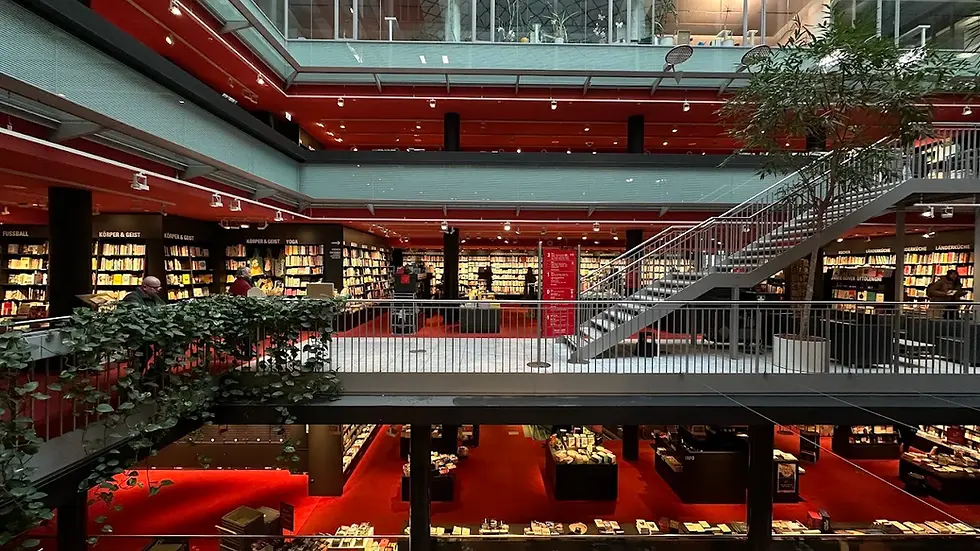
8. Berlin books: Head to Dussmann
For anyone who loves books, I have a particularly good recommendation: Dussmann das KulturKaufhaus on Friedrichstraße.
This enormous bookshop is spread over several floors and has an impressive selection of literature, music, films and cultural products.
What makes it especially useful for international visitors is its dedicated English Bookshop. You'll find plenty of English-language books about Berlin, German history, the Berlin Wall, the Second World War and much more.
If you're looking for a proper Berlin history book to take home, rather than another souvenir magnet, this is a great place to start.
You could easily spend an hour browsing here.

9. Berlin artwork, comics and unusual design
If you're looking for something a little more original, Berlin has a fantastic independent art and design scene. And there are two shops I'd particularly recommend.
Hidden away in the wonderfully alternative Haus Schwarzenberg at Rosenthaler Straße 39, Neurotitan is one of my favourite places to look for something different.
The shop specialises in independent illustration, comics, graphic art, prints and unusual design objects. You'll find work by local and international artists, often with a distinctly underground Berlin feel.
It's a great place to pick up an original print, an illustrated book or a small piece of artwork that you won't find in a conventional souvenir shop.
The gallery next door also regularly hosts exhibitions.
Another little gem can be found inside the Hackesche Höfe.
Levy's Contor is not your typical gift shop. Think of it as a wonderfully eclectic treasure chest filled with traditional toys, children's books, wooden animals, tin figures, brass lamps, games and selected Jewish-themed objects.
The shop was founded by Jakob Levy in 1997 and has been located in the Hackesche Höfe since 2005.
I particularly like the fact that you never quite know what you'll find here. It's the sort of place where you might discover something completely unexpected – and end up buying a gift you hadn't even been looking for.
Both shops are excellent alternatives to the standard tourist souvenirs.

10. Berlin museum shops: Often overlooked
One of my favourite places to find unusual gifts is actually inside Berlin's museums.
Museum shops are often overlooked by visitors, but they can be surprisingly good places to find well-designed souvenirs, books, prints and objects related to the city's history.
Two worth checking out are the shops at the Humboldt Forum and the DDR Museum.
The Humboldt Forum has a selection of books, design objects and cultural gifts, while the DDR Museum is a particularly good place to look for East German-themed memorabilia and playful reminders of everyday life behind the Iron Curtain.
Even if you don't have time for a full museum visit, it's worth having a look at the shops.

11. Beer steins and traditional German souvenirs
If you're after something traditionally German, you'll find plenty of beer steins, miniature beer mugs and other Bavarian-style souvenirs in Berlin's tourist shops.
Personally, I'd distinguish between things that are typically German and things that are typically Berlin.
Beer steins, dirndls, lederhosen and Oktoberfest merchandise are much more closely associated with Bavaria and southern Germany than with Berlin.
Of course, there's nothing wrong with buying them if that's what you're after! But if you want something that actually represents the city you're visiting, I'd go for the Ampelmännchen, a Buddy Bear or something connected to Berlin's history instead.

12. The classic tourist souvenirs
Sometimes you just want a simple souvenir, and there's nothing wrong with that.
You'll find plenty of the usual suspects throughout Berlin: refrigerator magnets, postcards, mugs, key rings, miniature landmarks and T-shirts.
A few other familiar options include:
Starbucks City Mugs: If you collect Starbucks mugs from different cities, you'll find Berlin editions in the city's Starbucks branches. And if you're wondering where to find a Starbucks in Berlin, don't worry – they're almost as widespread as in the US. Chances are, wherever you are, there's one within a five-minute walk. Pretty much every major tourist attraction seems to come with its own Starbucks!
Hard Rock Cafe merchandise: There are two Berlin locations, one on Kurfürstendamm and another near Checkpoint Charlie. Both sell the familiar branded T-shirts, pins and other collectibles.
Berlin beer glasses: A simple but useful reminder of your visit, particularly if you enjoyed sampling the local beer.
Brandenburg Gate miniatures: Perhaps not the most original gift, but certainly recognisable.
You'll find these in souvenir shops around major attractions, especially near the Brandenburg Gate, Checkpoint Charlie, Alexanderplatz and Hackescher Markt.

13. Nazi memorabilia: What you need to know
Some visitors ask me whether they can buy Nazi-era memorabilia in Berlin. The short answer is that you won't find the sort of Nazi souvenirs that you might encounter in some other countries.
Germany has strict laws concerning the public use and distribution of symbols associated with unconstitutional and terrorist organisations. This includes Nazi flags, insignia, slogans and similar symbols.
There are exceptions for legitimate historical, educational, artistic and scientific purposes, but this is not a market for ordinary tourist souvenirs.
You might encounter historical objects in museums or specialist historical collections, but don't expect to find Nazi flags, SS memorabilia or similar items in Berlin's souvenir shops.
And perhaps it's worth asking yourself whether buying such an item is appropriate in the first place. Some visitors are genuinely interested in history and imagine taking home something small, such as a 1930s-era button or everyday object. But remember what these objects represent and the history behind them. Not everything that can be collected necessarily makes an appropriate souvenir.
If you're interested in the history of National Socialism, I'd recommend visiting the Topography of Terror, the German Resistance Memorial Center or the Memorial to the Murdered Jews of Europe instead.
These are important places to understand the history of Nazi Germany and its consequences.

The best areas in Berlin for souvenir shopping
Now that you have an idea of what to buy, where should you actually go shopping?
Berlin is a huge city, and there isn't one single souvenir district. However, there are a few areas where you'll find a particularly good selection of shops.
Hackescher Markt and Hackesche Höfe
This is probably my favourite area for browsing independent shops and finding more unusual gifts.
You'll find several Ampelmann stores, Levy's Contor inside the Hackesche Höfe, Neurotitan at Haus Schwarzenberg and the Käthe Wohlfahrt Christmas shop nearby.
There are also plenty of smaller boutiques, design shops and galleries in the surrounding streets.
Kurfürstendamm and KaDeWe
If you prefer a more traditional shopping experience, head to Kurfürstendamm in western Berlin.
This famous shopping boulevard is lined with department stores, international brands and smaller shops. It's also home to the legendary KaDeWe (Kaufhaus des Westens), one of Europe's best-known department stores.
The food hall on the upper floors is particularly worth visiting if you're looking for edible gifts, German specialities, sweets or something a little more luxurious to take home.

Berlin's flea markets: For something truly unique
Berlin has some fantastic flea markets, and if you're visiting over a weekend, I'd definitely recommend checking one out. They're a fantastic place to find vintage objects, old photographs, second-hand books, records, antiques and unusual gifts.
Here are a few of my favourites:
Mauerpark Flea Market: Probably Berlin's most famous flea market. Open on Sundays, it's a lively place with hundreds of stalls selling vintage clothing, jewellery, artwork, records, design objects and all sorts of curiosities. It's also a great place to soak up the atmosphere of Berlin.
Antique Market at Ostbahnhof: A good option if you're particularly interested in older objects, DDR memorabilia, antiques and vintage finds.
Flea Market at Straße des 17. Juni: One of Berlin's traditional antique and second-hand markets, with a good selection of books, art, furniture and collectibles.
The book market at Bebelplatz: Located near Humboldt University, this is a lovely place to browse second-hand books and printed material when the market is taking place.
Don't necessarily expect to find a bargain at every stall, but if you're prepared to look around, you might discover something much more interesting than anything in a regular souvenir shop.
Ultimately, my advice is to look beyond the obvious tourist shops. Berlin has a fascinating history, a wonderfully creative design scene and plenty of independent stores where you can find something genuinely special.
And if you'd like to discover more of the city beyond its shopping streets, I'd be delighted to show you around. Join me on a private tour of Berlin and discover the history, neighbourhoods and hidden corners that make this city so special.


Comments