The Best World War II Sites in Germany: An Essential Guide for History Lovers
Germany is home to some of the most important World War II historical sites in the world. From Hitler's former headquarters in Berlin to the concentration camps that bear witness to Nazi crimes, from the beaches of the political rise of the Nazi Party in Munich to the battlefields where American troops fought their way into Germany, the country offers an extraordinary opportunity to understand the history of the Second World War.
For anyone planning a trip to Germany to explore its wartime past, the challenge is deciding where to begin. The sites are spread across the country, and many deserve several hours of careful exploration.
My recommendation? Start in Berlin.
As the capital of Nazi Germany, Berlin was the political centre of the regime. It was here that Hitler's government consolidated its power, that the machinery of persecution and genocide was coordinated, and that the war finally came to an end in the ruins of the city in May 1945. Today, Berlin preserves an extraordinary collection of memorials, museums, former Nazi government buildings and surviving traces of the war.
But there is much more to discover beyond the capital. Within easy reach of Berlin are Potsdam, Sachsenhausen and Ravensbrück, while further afield you'll find Nuremberg's Nazi rally grounds, Munich's early Nazi history, the concentration camps of Buchenwald and Dachau, and battlefields associated with the final Allied advance into Germany.
Whether you're interested in military history, the Holocaust, the German resistance, the rise and fall of Hitler, or the experiences of American and Soviet soldiers in Europe, this guide will help you plan a meaningful World War II history trip to Germany.
1. Berlin: The Best Place to Begin Your World War II History Trip
Berlin should be at the top of any list of the best WWII sites in Germany. No other city brings together so many different aspects of the story in one place: the rise of the Nazi Party, the institutions of dictatorship, the persecution of Europe's Jews, German resistance, the Battle of Berlin and the consequences of the war. You could spend several days exploring the city's history without running out of places to visit. These are the sites I'd prioritise.
The Topography of Terror
If you visit just one museum about Nazi Germany in Berlin, make it the Topography of Terror.
Located on the former grounds of the Gestapo headquarters and the leadership offices of the SS, this documentation centre examines how the Nazi dictatorship organised persecution and terror. Exhibitions explain the development of the regime, its institutions, its crimes in Germany and occupied Europe, and the road to the end of the war.
Particularly powerful is the fact that you're standing on the very site where many of these crimes were organised. The surviving foundations and outdoor exhibition make the history tangible in a way that a conventional museum cannot.
The Topography of Terror is also next to a surviving section of the Berlin Wall, bringing together two defining chapters of twentieth-century German history. Admission is free. Allow at least two hours.

The Führerbunker: Where Hitler Died
Few places associated with World War II generate as much curiosity as the Führerbunker, where Adolf Hitler spent his final weeks and died by suicide on 30 April 1945.
The bunker was part of a larger underground complex near the Reich Chancellery. As Soviet troops fought their way into Berlin, Hitler remained underground while the Nazi regime collapsed around him.
Today, there is no museum or accessible bunker interior. Most of the complex was demolished after the war, and the site is now largely occupied by ordinary urban development. An information panel marks the location.
That apparent ordinariness is part of what makes the place so striking. One of the most infamous locations in modern history is now surrounded by everyday Berlin life.

The Reichstag and the Reichstag Fire
The Reichstag, Germany's parliament building, is one of Berlin's most recognisable landmarks. Its history is inseparable from the destruction of German democracy.
On 27 February 1933, just weeks after Hitler became chancellor, a fire devastated the building. The Nazis used the Reichstag Fire Decree issued the following day to suspend fundamental civil liberties and facilitate the persecution of political opponents. The fire and its political consequences became a decisive step in the consolidation of Nazi power.
The building you see today was extensively restored and redesigned after German reunification. Its glass dome symbolises parliamentary transparency, a deliberate contrast with the dictatorship that once ruled from Berlin.
You can visit the Reichstag dome with advance registration, subject to availability and security requirements.

The Former Reich Aviation Ministry
Built under Hermann Göring's direction, the former Reich Aviation Ministry is one of the largest surviving government buildings from the Nazi period in central Berlin.
Today it houses Germany's Federal Ministry of Finance. The building itself is not generally a museum open for unrestricted interior visits, but its exterior is worth seeing as part of a walk through the former Nazi government district.
Its survival offers an unusually direct connection to the architecture of the regime. It also illustrates how buildings associated with dictatorship can acquire entirely different functions in a democratic state.

The Memorial to the Murdered Jews of Europe
Close to the Brandenburg Gate is Berlin's Memorial to the Murdered Jews of Europe, one of the most important Holocaust memorials in the world.
Designed by architect Peter Eisenman, the memorial consists of 2,711 concrete stelae arranged across a gently undulating field. Walking between them creates a disorientating experience that changes with every step.
Beneath the memorial is an information centre documenting the persecution and murder of European Jews, including personal stories, family histories and accounts of deportation.
The memorial is not a substitute for learning about the Holocaust, but it is an essential place to pause and reflect. I strongly recommend visiting the information centre as well as walking through the outdoor memorial.

The German Resistance Memorial Center at Bendlerblock
Nazi Germany was not without opposition. The German Resistance Memorial Center, located in the historic Bendlerblock complex, tells the story of those who resisted Hitler's dictatorship.
The site is especially associated with the failed coup of 20 July 1944, led by officers including Claus Schenk Graf von Stauffenberg. After the attempt to assassinate Hitler failed, Stauffenberg and several fellow conspirators were executed in the courtyard.
The exhibition goes far beyond this famous episode, however. It explores the many different forms of resistance, from individual acts of defiance to religious opposition, political underground movements and efforts to rescue persecuted Jews.
It is an important reminder that German society was not uniformly supportive of the Nazi regime, even though resistance came at enormous personal risk.
The Book Burning Memorial at Bebelplatz
On 10 May 1933, Nazi supporters and students burned thousands of books in Berlin's Bebelplatz. The works targeted included writings by Jewish authors, political opponents and intellectuals regarded as enemies of the regime.
Today, a memorial by artist Micha Ullman takes the form of an underground library visible through a glass panel in the square. Its empty white shelves are a simple but powerful symbol of censorship and cultural destruction.
Bebelplatz is close to Unter den Linden, making it easy to combine with the Brandenburg Gate, the Reichstag and other central Berlin landmarks.

The Berlin Story Bunker and Anhalter Bahnhof
For a different perspective on Berlin's wartime history, visit the Berlin Story Bunker near Anhalter Bahnhof.
Housed in a former air-raid shelter, the museum presents an extensive narrative of Berlin's history, including the Nazi period and the destruction of the city during the war.
Nearby, the monumental remains of Anhalter Bahnhof offer another reminder of wartime destruction. Once one of Berlin's great railway stations, it was badly damaged during the war and demolished in the post-war period. Only part of its impressive entrance façade survives.
The combination of underground shelter and ruined railway architecture helps bring the wartime experience of Berlin's civilians into focus.

Berlin's wartime history is not confined to museums and memorials. Look carefully at older buildings and you may still spot bullet holes and other damage from the fighting of 1945.
Some surviving structures preserve visible traces of the final battle, although individual marks should not automatically be attributed to a particular event without evidence.
The Battle of Berlin was fought in April and early May 1945, as Soviet forces advanced into the city. Street fighting, artillery bombardment and air attacks left much of the urban landscape in ruins.
Exploring Berlin with an experienced guide can help you distinguish genuine wartime traces from later damage and understand how the battle unfolded across the city.

The Soviet War Memorials in Tiergarten and Treptower Park
Berlin contains several major Soviet memorials commemorating the Red Army soldiers who died in the battle for the city.
The Soviet War Memorial in Tiergarten, near the Brandenburg Gate, is centrally located and easy to incorporate into a walking tour. It was erected in 1945 and also serves as a burial site for Soviet soldiers.
The larger Soviet War Memorial in Treptower Park is one of Berlin's most monumental memorial complexes. Its vast landscaped grounds, sculptural figures and central statue of a Soviet soldier commemorate the Soviet dead of the Battle of Berlin.
Treptower Park deserves a dedicated visit. It is a powerful place to consider the enormous Soviet military sacrifice involved in defeating Nazi Germany, alongside the complicated history of post-war Soviet influence in eastern Europe.

Gleis 17 at Grunewald Station
Gleis 17, or Platform 17, at Berlin-Grunewald railway station is one of the city's most moving Holocaust memorials.
From this station, thousands of Jewish residents of Berlin were deported to ghettos and concentration camps between 1941 and 1945. Metal plates along the platform record the dates, destinations and numbers of people transported.
The memorial's understated design makes it particularly effective. Rather than relying on a large monument, it allows the historical record itself to speak.
It's a little outside the city centre, but well worth visiting for anyone interested in the Holocaust and the deportation of German Jews.

The Kaiser Wilhelm Memorial Church
The ruined tower of the Kaiser Wilhelm Memorial Church on Breitscheidplatz is one of Berlin's best-known landmarks.
The church was heavily damaged in Allied bombing during the war. Rather than demolish the remaining tower, post-war Berlin preserved it as a memorial to destruction and reconciliation.
The modern church buildings beside the ruin create a striking contrast between the damaged historic structure and the architecture of post-war reconstruction.
It is an especially useful stop for understanding the physical destruction of Berlin and how the city chose to remember it.

The Olympic Stadium: Nazi Architecture and the 1936 Olympics
Berlin's Olympic Stadium was built for the 1936 Summer Olympics, an international sporting event that the Nazi regime used to promote its image and ideology.
The Games were designed to present Germany as modern, orderly and welcoming, while the regime continued to persecute Jews and other targeted groups. International attention and propaganda were central to the event.
The stadium remains an impressive example of monumental architecture from the Nazi period. Visitors can explore the grounds and learn how sport became an instrument of political messaging.

Karlshorst: Where Germany Surrendered
The German-Russian Museum in Berlin-Karlshorst occupies the historic site where the German armed forces signed the final act of unconditional surrender on the night of 8–9 May 1945.
The surrender marked the end of the war in Europe. The museum explores the German-Soviet war, the occupation of eastern Europe and the wider history of Nazi Germany's war of annihilation in the Soviet Union.
For visitors who want to understand how the war ended, Karlshorst is one of the most significant historical locations in Berlin.

The House of the Wannsee Conference: Where the Holocaust Was Coordinated
Located in a beautiful villa on the shores of Lake Wannsee in southwest Berlin, the House of the Wannsee Conference is one of the most significant historical sites associated with the Holocaust.
On 20 January 1942, senior representatives of the Nazi regime and the SS met here for a conference chaired by Reinhard Heydrich, head of the Reich Security Main Office. Their meeting focused on coordinating the deportation of Europe's Jews as part of what the Nazis called the “Final Solution to the Jewish Question” — the systematic persecution and murder of European Jews.
Contrary to a common misconception, the Holocaust did not begin at this meeting. Mass shootings of Jews had already taken place on a vast scale in German-occupied eastern Europe, and the Nazis had already begun murdering Jews in extermination camps. The Wannsee Conference was nevertheless a crucial moment in coordinating the participation of different government departments in the genocide.
Today, the villa houses a permanent exhibition documenting the persecution and murder of European Jews, the development of Nazi antisemitic policies, and the bureaucratic machinery behind the Holocaust. The conference room itself is a particularly sobering place to visit: the setting is elegant and peaceful, in stark contrast to the crimes discussed there.

The Berlin Wall: A Consequence of World War II
Although the Berlin Wall was not built until 1961, it belongs in any wider exploration of the consequences of World War II.
Germany's defeat led to occupation by the four Allied powers and, eventually, the division of the country into two states. Berlin itself was divided despite being located deep inside the Soviet occupation zone.
The Wall became the most visible symbol of the Cold War and the division of Europe. Visiting sites such as the Berlin Wall Memorial or the preserved stretch beside the Topography of Terror helps connect the end of World War II with the political order that followed.
Berlin is therefore more than a city of wartime ruins. It is a place where the rise of Nazism, the Holocaust, military defeat, occupation and the Cold War can be understood as connected chapters of history.
Planning a visit? A private WWII and Third Reich tour of Berlin is a good way to connect these locations, many of which make far more sense when you understand their geographical and historical relationships.
2. Day Trips from Berlin: Potsdam, Sachsenhausen and Beyond
Berlin is an excellent base for exploring important WWII sites in the surrounding region. Several destinations can be reached in under two hours, making them practical additions to a longer stay.
Potsdam: The Cecilienhof Palace and the Potsdam Conference
Potsdam is best known for its royal palaces and gardens, but it also played a crucial role in shaping post-war Europe.
At Cecilienhof Palace, the leaders of the United States, Britain and the Soviet Union met from 17 July to 2 August 1945. The Potsdam Conference addressed the occupation and administration of defeated Germany, reparations, borders and the future of Europe.
The palace's historic rooms and exhibition provide a direct connection to the diplomatic decisions made in the aftermath of the war.
For American visitors, the conference is particularly significant because President Harry S. Truman attended shortly after taking office following Franklin D. Roosevelt's death.

Truman's "Little White House" in Babelsberg
During the Potsdam Conference, Truman stayed at Villa Urbig in the Babelsberg district, often referred to as the "Little White House."
The villa itself is not a regular public museum, but its connection to the American president makes it an interesting additional stop for visitors exploring Potsdam's post-war history.
Join me on a private tour of Potsdam, exploring the city’s wartime history, the 1945 Potsdam Conference, and the legacy of the Nazi regime.
Potsdam's Garrison Church
Potsdam's Garrison Church has a complicated history that predates the Nazi era but became deeply associated with Nazi propaganda.
On 21 March 1933, Hitler and President Paul von Hindenburg appeared together at a ceremony in Potsdam, an event later known as the Day of Potsdam. The carefully staged occasion was intended to present Hitler as the heir to Prussian tradition and helped lend the new regime an appearance of legitimacy.
The church was destroyed in the final weeks of World War II, and its reconstruction has since been the subject of considerable public debate.
It is a useful place to examine how historical symbols and national traditions can be appropriated for political purposes.
The KGB Prison in Potsdam: Soviet Secret Police and Political Repression
The Leistikowstraße Memorial in Potsdam occupies a former church welfare building that became a central remand prison for Soviet military counterintelligence in the Soviet-occupied zone of Germany after World War II. From 1945 until 1991, the facility was used by Soviet security services, including the KGB in its later years, to detain and interrogate suspected spies and political opponents.
Prisoners endured isolation, harsh conditions and, in some cases, physical and psychological torture. Some were accused of genuine espionage, while others were imprisoned on the basis of suspicion or false allegations. Today, the preserved cells, solitary-confinement rooms and prisoners' inscriptions on the walls bear witness to the experiences of those detained here.
The memorial offers an important perspective on the Soviet occupation and the repression that followed Nazi Germany's defeat. It also helps explain Potsdam's role as a centre of Soviet military and intelligence activity during the Cold War. The permanent exhibition explores the prison's history and the fates of its inmates.

Sachsenhausen Concentration Camp Memorial
Located in Oranienburg, north of Berlin, Sachsenhausen was established in 1936 and became one of the major concentration camps within the Nazi camp system.
Prisoners included political opponents, Jews, Roma, Soviet prisoners of war and people persecuted for numerous other reasons. The camp also served as an administrative and training centre within the SS concentration camp system.
Today, the memorial preserves parts of the former camp and presents exhibitions about imprisonment, forced labour, systematic violence and the experiences of survivors.
Allow several hours for a visit. The site is emotionally demanding, and it deserves more than a hurried stop on a busy sightseeing day.
Join me on a private tour of Sachsenhausen Memorial, learning about the history of the Nazi concentration camp, the suffering of its prisoners, and the crimes committed under the Nazi regime.

Ravensbrück Concentration Camp Memorial
Ravensbrück, near the town of Fürstenberg/Havel, was the largest Nazi concentration camp established primarily for women.
Tens of thousands of women from across occupied Europe were imprisoned there. Prisoners were subjected to forced labour, starvation, abuse and medical experiments. Men and children were also imprisoned within the wider camp complex.
The memorial provides an essential perspective on the gendered dimensions of Nazi persecution and the experiences of women who resisted occupation, were targeted for political reasons or were persecuted under Nazi racial policies.
Ravensbrück is further from Berlin than Sachsenhausen, so it is best treated as a dedicated day trip.
Join me on a private tour of Ravensbrück Memorial, exploring the history of Nazi Germany’s largest concentration camp for women, the experiences of its prisoners, and the stories of courage, suffering, and survival.

Brandenburg an der Havel: The Nazi "Euthanasia" Murders
The town of Brandenburg an der Havel was one of the central locations in the Nazi regime's systematic murder of people with disabilities and psychiatric patients.
At the Brandenburg killing centre, patients were murdered in a gas chamber in 1940 as part of the programme commonly known as Aktion T4. The methods and personnel involved in these killings formed part of the broader history of Nazi mass murder.
The Brandenburg an der Havel Memorial documents the victims and the development of the killing programme. It is an important, often overlooked destination for anyone seeking to understand Nazi crimes beyond the concentration camps.
Zuchthaus Brandenburg-Görden: Nazi Prison and Place of Execution
The Brandenburg-Görden prison, located in Brandenburg an der Havel, was one of the most important execution sites in Nazi Germany. During the Third Reich, the prison held political opponents, resistance fighters and other people sentenced by the Nazi justice system. Between 1940 and 1945, more than 2,000 people were executed here, including members of resistance groups and opponents of the regime.
Today, the memorial commemorates the victims of Nazi judicial persecution and explores the role of the justice system in enforcing dictatorship. It offers an important perspective on Nazi terror beyond the concentration camps, showing how courts and prisons were used to silence opposition and punish resistance.
North of Berlin, near Wandlitz, lies the Bogensee estate, associated with Joseph Goebbels, Hitler's propaganda minister.
Goebbels used the property as a country retreat, and the surrounding site later acquired additional buildings during the Nazi era. The estate subsequently served different purposes under East German rule.
The complex has attracted interest because of its scale and its connection to one of the regime's most influential figures. However, it is not a conventional tourist attraction, and access to the buildings and grounds may be restricted. I'm happy to take you there!

Beelitz-Heilstätten: Where Hitler Was Treated During World War I
The abandoned hospital complex at Beelitz-Heilstätten is often associated with the early life of Adolf Hitler.
Hitler was treated there in late 1916 after being wounded while serving in the First World War. The hospital complex later became a large military medical facility and is now known for its striking abandoned buildings and forest setting.
It is important to distinguish this history from World War II itself: Hitler's treatment at Beelitz took place during the First World War. Nevertheless, the site can be an interesting addition to a broader exploration of his biography and the origins of the Nazi leader.
Some parts of the complex have been developed for visitors, while others are inaccessible or unsafe. Use official visitor routes rather than entering abandoned buildings.

Seelow Heights: The Final Battle for Berlin
The Seelow Heights, east of Berlin, were the scene of one of the last major battles of World War II in Europe.
In April 1945, Soviet forces attacked German defensive positions on the heights as they prepared to advance toward Berlin. The fighting was intense, involving artillery bombardment, infantry assaults and heavy casualties.
The Seelow Heights Memorial and Museum explain the battle and the final Soviet offensive that brought the war to the German capital.
For visitors interested in military history, this is one of the most significant battlefields within reach of Berlin.
Join me on a private tour of Seelow Heights, exploring the dramatic final battle on the Eastern Front in April 1945, the Soviet advance on Berlin, and the events that led to the end of World War II in Europe.

Zossen and Wünsdorf: Germany's Military Command Centre
South of Berlin, the Zossen-Wünsdorf area became an important centre for German military planning and command.
The underground Maybach bunker complex and other military installations were used by the German armed forces during the war. The area also has a much longer military history, including major roles during the First World War and the Cold War.
Today, guided visits and specialist tours may be available at selected sites. Check the current programme before travelling, as access to individual bunkers and installations varies.

Peenemünde: The Birthplace of the V-2 Rocket
On the Baltic island of Usedom, the Peenemünde Historical-Technical Museum explores the German rocket research programme developed during the Nazi era.
Scientists and engineers, including Wernher von Braun, worked on the V-2 rocket here. The programme represented a major technological development in rocketry, but its military use was devastating. V-2 attacks killed civilians in Allied cities, and the production programme relied on brutal forced labour, including prisoners from Mittelbau-Dora.
The museum examines the relationship between technological innovation, military ambition, forced labour and the legacy of the rocket programme after 1945.
Peenemünde is particularly worthwhile for visitors interested in military technology and the ethical questions surrounding scientific research under dictatorship.

Prora: The Nazi Seaside Resort
On the Baltic island of Rügen, Prora is a vast complex originally conceived as a holiday resort for the Nazi organisation Strength Through Joy.
The project was intended to provide organised leisure facilities for German workers and demonstrate the regime's promise of social benefits. Construction began before the war, but the resort was never completed or used as originally planned.
Prora illustrates how the Nazi regime attempted to shape everyday life as well as military and political institutions. Exhibitions and historical displays in the complex explore its construction, ideology and later uses.
It is a worthwhile stop for visitors interested in propaganda, architecture and the social history of Nazi Germany.
Join me on a private tour of Prora and Peenemünde, exploring two remarkable sites of Nazi Germany’s wartime history—from the regime’s monumental seaside resort project to the secret development of V-2 rockets and the use of forced labor during World War II.

3. Nuremberg: Nazi Rallies and the War Crimes Trials
Nuremberg occupies a central place in the history of Nazi Germany. The city hosted the regime's spectacular mass rallies and later became the setting for the international trials of leading Nazi figures.
The Nazi Party Rally Grounds
The enormous rally grounds were designed to stage mass spectacles that reinforced Hitler's authority and created a sense of unity between the regime and its supporters.
The unfinished structures, including parts of the Congress Hall complex, reveal the scale of the Nazis' architectural ambitions. The documentation centre examines the use of propaganda, the organisation of the rallies and the relationship between spectacle and dictatorship.
The site is especially useful for understanding how the Nazi Party turned public events into instruments of political mobilisation.

Courtroom 600 and the Nuremberg Trials
After the war, Nuremberg became the setting for the International Military Tribunal, where leading figures of the Nazi regime were prosecuted for crimes including crimes against peace and war crimes.
The trials established an important precedent for international criminal justice and confronted the world with documentary evidence of Nazi atrocities.
The Memorium Nuremberg Trials explores the proceedings, the defendants and the wider legacy of the trials. Courtroom 600 is the most famous location, although access can depend on court use and museum arrangements.

The Historic Art Bunker
Beneath Nuremberg's old town lies a network of historic cellars, including spaces used to protect works of art during World War II.
The Historic Art Bunker was adapted to safeguard cultural treasures from bombing and destruction. It is also part of the wider story of the protection, removal and recovery of artworks during the war, including works threatened by the Nazi regime's policies of looting and confiscation.
Guided visits explain the cellars' history and how cultural heritage was protected during wartime.
Nuremberg is an excellent destination for a full day or overnight stop, combining Nazi architecture, the history of propaganda and the post-war pursuit of justice.
4. Munich: Where the Nazi Movement Began
Munich was the birthplace of the Nazi movement's rise to national prominence. Hitler's political career developed here, and the city became an important centre of Nazi ideology long before the outbreak of World War II. My colleague Steve offers WW2 tours here!
Dachau Concentration Camp Memorial
Established in March 1933, Dachau was one of the first permanent concentration camps created by the Nazi regime.
Initially used primarily to imprison political opponents, it later became a model for the wider concentration camp system. Prisoners included Jews, religious opponents, resistance members and people targeted by Nazi racial and social policies.
Today, the Dachau Concentration Camp Memorial Site documents the camp's history, the experiences of prisoners, the system of persecution and the liberation of the camp by US forces in April 1945.
Dachau is one of the most important WWII sites in Germany and can be visited as a day trip from Munich.

Königsplatz: Nazi Rallies and Architecture
Königsplatz became a major ceremonial space for the Nazi Party in Munich.
The square was used for rallies and political events, and the surrounding buildings formed part of the regime's architectural landscape. The nearby former Nazi Party headquarters and associated structures help explain how Munich became a centre of Nazi political life.
The buildings and public spaces are a useful starting point for exploring the movement's origins and the way it reshaped the city.

The Feldherrnhalle and the Beer Hall Putsch
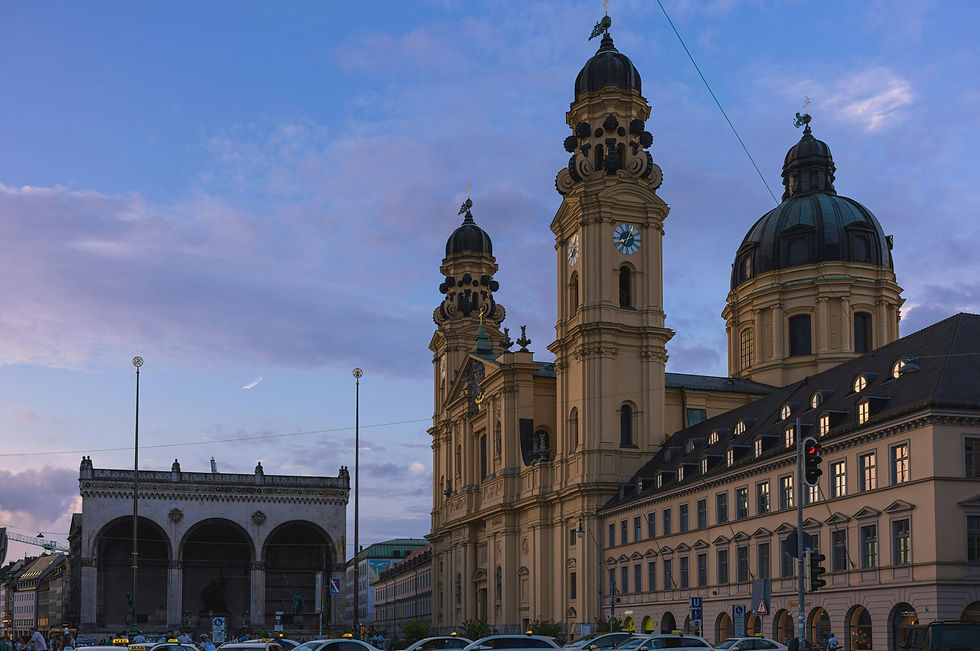
The Feldherrnhalle on Odeonsplatz is closely associated with Hitler's failed Beer Hall Putsch of November 1923.
The attempted coup began in Munich and ended in violence near the Feldherrnhalle, where police confronted the Nazi marchers. Hitler was arrested and later tried for treason. His trial gave him national publicity, and his imprisonment provided the opportunity to write Mein Kampf.
After taking power, the Nazis transformed the site into a place of political commemoration, requiring passers-by to show deference to the regime. Some Munich residents avoided the official route by taking a nearby side street, Viscardigasse, which became associated with quiet acts of defiance.
The site helps explain how a failed coup became a foundational myth for the Nazi movement.
The NS Documentation Center Munich
The NS Documentation Center provides a comprehensive overview of Munich's role in the rise of National Socialism.
Its exhibitions explore the origins of the Nazi Party, the city's relationship with the movement, the consolidation of dictatorship and the consequences of Nazi rule.
For anyone interested in how the regime developed before the war, this is one of the most useful museums in Germany.
The White Rose Trials at the Justizpalast
The Munich Palace of Justice, or Justizpalast, is associated with the trials of members of the White Rose resistance group.
The group included students Hans and Sophie Scholl and their fellow activist Christoph Probst. They distributed leaflets calling for resistance to the Nazi regime and were arrested in 1943. The People's Court sentenced them to death, and they were executed shortly afterwards.
A memorial exhibition in the Palace of Justice tells their story and explains the importance of civil courage under dictatorship.
Georg Elser and the Attempt to Kill Hitler
Georg Elser was a German carpenter who attempted to assassinate Hitler in November 1939 by planting a bomb in Munich's Bürgerbräukeller, where Hitler was due to speak.
The bomb exploded after Hitler had unexpectedly left the building early, killing several people but failing to kill its intended target. Elser was later imprisoned and murdered by the Nazi regime in 1945.
His story is an important reminder that resistance was not limited to military officers or organised political groups. Individuals also took enormous risks to try to stop Hitler. Several memorials honor him in Munich.
The Berghof and the Eagle's Nest
In the Bavarian Alps near Berchtesgaden, Hitler maintained his mountain residence, the Berghof, which became one of the most important centres of Nazi leadership.
The surrounding Obersalzberg area housed other residences and facilities used by senior Nazi figures. The Berghof itself was destroyed after the war, but the Documentation Center Obersalzberg examines the site's history and the regime's use of the Alpine landscape.
Nearby is the Eagle's Nest, or Kehlsteinhaus, a mountaintop building constructed for Nazi officialdom and used for receptions. It is not the same building as Hitler's Berghof, and the distinction is worth making when visiting.
The spectacular mountain scenery contrasts sharply with the political crimes associated with the area. The documentation centre provides the historical context necessary to understand the site responsibly.

5. Concentration Camps and Memorials Across Germany
Germany's concentration camp memorials are among the most important historical sites in the country. Each has its own history, and together they reveal the diversity and scale of Nazi persecution, forced labour, mass murder and imprisonment.
A visit to any of these sites should be approached with time, care and respect.
Buchenwald, Near Weimar
Buchenwald was one of the largest concentration camps on German soil. Established in 1937 near Weimar, it held political prisoners, Jews, Roma, prisoners of war and many others targeted by the regime.
Prisoners endured forced labour, violence, starvation and systematic abuse. The camp was liberated by US forces in April 1945, after prisoners had also organised resistance within the camp.
The Buchenwald Memorial includes the former camp grounds, exhibitions and memorial spaces. Its location near Weimar, a city closely associated with German classical culture, makes the contrast between cultural achievement and Nazi brutality particularly stark.

Bergen-Belsen, Lower Saxony
Bergen-Belsen began as a prisoner-of-war camp and later became a concentration camp. By the final months of the war, overcrowding, starvation and disease had caused catastrophic loss of life.
British forces liberated the camp in April 1945. The scenes they encountered were documented by soldiers, journalists and medical personnel, making Bergen-Belsen one of the best-known sites associated with the liberation of Nazi camps.
Anne Frank and her sister Margot died at Bergen-Belsen in 1945. The memorial and documentation centre tell the story of the camp and its victims, as well as the experiences of those who survived.

Mittelbau-Dora: Forced Labour and the V-2 Rocket
Near Nordhausen in Thuringia, the Mittelbau-Dora concentration camp complex was established to provide forced labour for underground weapons production.
Prisoners were forced to work in tunnels and underground factories connected with the production of V-2 rockets. Conditions were brutal, and thousands died from exhaustion, disease, violence and the wider camp system.
The memorial site explains the relationship between Nazi military technology, forced labour and the concentration camp system. It also connects directly to the rocket research conducted at Peenemünde.
Flossenbürg Concentration Camp Memorial
Located in Bavaria near the Czech border, Flossenbürg was established in 1938 and became a major site of forced labour, particularly in quarrying and armaments production.
As the war progressed, the camp system expanded through a network of subcamps connected to industrial production. Prisoners faced extreme conditions, and large numbers died.
The memorial preserves parts of the camp and documents the experiences of prisoners and the history of forced labour.

6. The Western Front: American Battlefields and the Allied Advance into Germany
For American visitors, western Germany and the neighbouring regions of Belgium and Luxembourg offer some of the most significant sites associated with the US Army's campaign of 1944–45.
These locations help explain how Allied forces crossed into Germany, fought through heavily defended terrain and eventually advanced toward the Rhine and Berlin.
Remagen: The Bridge Across the Rhine
On 7 March 1945, US forces captured the Ludendorff Bridge at Remagen before German troops could demolish it.
The unexpected capture gave the Allies a valuable bridgehead across the Rhine, one of Germany's major natural defensive barriers. Although the bridge later collapsed, the episode became a symbol of the rapid and sometimes unpredictable advance of the Allied armies.
The Peace Museum in the bridge's surviving towers explores the bridge's history and the final campaign in western Germany.
Hürtgen Forest: One of the US Army's Costliest Campaigns
The Hürtgen Forest, near the Belgian border, was the scene of prolonged and costly fighting between American and German forces in late 1944 and early 1945.
Dense woodland, difficult terrain, poor weather, mines and German defensive positions made the campaign particularly challenging. US forces suffered heavy losses during repeated attempts to advance through the forest.
Today, the landscape retains a number of wartime traces, and memorials help explain the battle. It is a worthwhile destination for those interested in the ground-level experience of American soldiers fighting in Europe.
Aachen: The First Major German City Captured by US Forces
Aachen was captured by American troops in October 1944, becoming the first major German city to fall to the Western Allies.
The battle involved intense urban fighting and considerable destruction. It also demonstrated the determination of the Nazi regime to defend German territory even as the military situation deteriorated.
Aachen's history connects the campaign in the border regions with the wider struggle to break through Germany's western defences.

The Westwall and the "Dragon's Teeth"
The Westwall, known to the Allies as the Siegfried Line, was a defensive system built along Germany's western frontier.
It included bunkers, pillboxes, anti-tank obstacles and other fortifications. Some surviving concrete barriers are known as "dragon's teeth" because of their distinctive shape.
The Höckerlinie near Aachen and other surviving sections help visitors understand the scale of Germany's border defences and the challenges faced by Allied troops.
The Westwall Museum in Bad Bergzabern offers another perspective on the fortifications and their role in the war.

Remains of the Battle of the Bulge
Although much of the Battle of the Bulge took place in Belgium and Luxembourg, the campaign is essential to understanding the fighting around Germany's western border in the winter of 1944–45.
German forces launched a major offensive through the Ardennes in December 1944, hoping to split the Allied armies and regain the initiative. The attack ultimately failed, but the fighting was fierce and costly.
For a deeper exploration, combine western Germany with the Ardennes region across the borders in Belgium and Luxembourg.
American Military Cemeteries
Several American military cemeteries in the region provide moving places to reflect on the human cost of the campaign.
The Henri-Chapelle American Cemetery in Belgium contains the graves of thousands of US service members. The Luxembourg American Cemetery is the final resting place of more than 5,000 American military dead, including General George S. Patton.
The Ardennes American Cemetery in Belgium is another important site for those tracing the Battle of the Bulge.
Although these cemeteries are outside Germany, they can be worthwhile additions to an itinerary focused on the Western Front and the liberation of western Europe.

Wewelsburg Castle: Heinrich Himmler's SS Headquarters
Located near Büren in North Rhine-Westphalia, Wewelsburg Castle is one of the most unusual and unsettling Nazi historical sites in Germany. From 1934, SS leader Heinrich Himmler planned to transform the Renaissance castle into a central ideological meeting place for the SS, Hitler's powerful paramilitary organisation. The castle's North Tower contains rooms designed under the Nazis, including the infamous circular hall that has since become associated with neo-Nazi mythology.
The ambitious building project relied on prisoners from the nearby Niederhagen concentration camp, where at least 1,285 people died. Today, the Wewelsburg Memorial Museum houses the permanent exhibition Ideology and Terror of the SS, exploring the organisation's history, its racial ideology and its central role in the Holocaust and other Nazi crimes. The castle is an important destination for anyone interested in the ideology and inner workings of Hitler's regime.
7. Torgau: Where American and Soviet Troops Met
On 25 April 1945, American and Soviet troops met at the Elbe River near Torgau, in eastern Germany.
The encounter became one of the most famous symbolic moments of the war's final phase. The two armies had advanced from opposite directions and were now closing the remaining gap between the Western and Eastern Fronts.
The meeting at Torgau represented the military collapse of Nazi Germany, but it also foreshadowed the post-war division of Europe into competing spheres of influence.
For visitors exploring the end of World War II, Torgau is a meaningful destination that connects the military campaign with the political order that emerged afterwards.

8. Hamburg and Northern Germany: Bombing, Concentration Camps and Nazi Military Industry
Hamburg played a major role in Germany's war economy and suffered devastating Allied bombing during World War II. The surrounding region also contains important memorials documenting Nazi forced labour, the persecution of prisoners and the construction of military infrastructure.
Neuengamme Concentration Camp Memorial
Located southeast of Hamburg, Neuengamme was one of northern Germany's largest concentration camps. Prisoners were subjected to forced labour, particularly in brick production and construction, and thousands died from starvation, disease, violence and exhaustion. Today, the memorial preserves parts of the former camp and documents the experiences of its prisoners and the wider system of Nazi forced labour.

St. Nicholas' Church Memorial
Hamburg was devastated by Allied air raids during Operation Gomorrah in July and August 1943. The bombing caused enormous destruction and killed tens of thousands of people. The surviving tower of St. Nicholas' Church now serves as a memorial to the victims of the air raids and a reminder of the devastating impact of aerial warfare on civilians.

The Green Bunker at Feldstraße
One of Hamburg's most striking wartime structures is the enormous bunker at Feldstraße, originally built as an air-raid shelter and anti-aircraft installation. Now known as the Green Bunker, the structure has been adapted for modern use. Its massive scale illustrates the efforts made to defend German cities and shelter civilians during the Allied bombing campaign.
Join me on a private tour of Hamburg during World War II, exploring the impact of Nazi rule, the devastating Allied bombing raids of Operation Gomorrah, and the city’s complex wartime history, including the Neuengamme concentration camp.

While You're in Hamburg: Bunker Valentin Memorial
Located near Bremen, approximately an hour to an hour and a half from Hamburg by car, Bunker Valentin is one of the largest surviving military structures from Nazi Germany. Constructed between 1943 and 1945, the enormous concrete bunker was intended to serve as a bomb-resistant submarine assembly facility for the German Navy. Measuring approximately 426 metres (1,400 feet) in length, it was one of the largest military construction projects of the Nazi regime.
Thousands of forced labourers, prisoners of war and concentration camp inmates were forced to work under brutal conditions to build the structure. More than 1,100 people died during its construction. The bunker was never completed or used to produce submarines.
Today, the Bunker Valentin Memorial explores the Nazi war economy, forced labour and the human suffering behind Hitler's military ambitions. Its sheer size makes it one of the most striking WWII sites in northern Germany and a worthwhile addition to a longer visit to Hamburg.
9. How to Plan a World War II Trip Through Germany
Germany is a large country, and attempting to visit every major WWII site in one trip would be exhausting. The best approach is to focus on a few regions and allow enough time to understand each place.
Three Days in Berlin
A three-day stay in Berlin is a good starting point for anyone interested in the Nazi era and World War II.
Day 1: Explore the former government district, including the Reichstag, Brandenburg Gate, Memorial to the Murdered Jews of Europe, Wilhelmstraße and the Topography of Terror.
Day 2: Visit the German Resistance Memorial Center, the former Olympic grounds or the Berlin Story Bunker, then explore the Soviet War Memorial in Treptower Park.
Day 3: Choose a specialist day trip to Sachsenhausen, or explore the House of the Wannsee Conference and Gleis 17.
This itinerary combines the political history of the regime with the Holocaust, resistance and the end of the war.
Five Days: Berlin and Potsdam
With five days, you can explore Berlin more thoroughly and add Potsdam.
Spend three days in Berlin, then dedicate a day to the Potsdam Conference at Cecilienhof Palace and the historic sites around Babelsberg. Use the remaining day for Sachsenhausen or another site of particular interest.
Seven to Ten Days: Berlin and Central Germany
A longer trip allows you to explore the capital before travelling further afield.
After several days in Berlin, consider Potsdam and Sachsenhausen, then continue to Nuremberg for the Nazi rally grounds and the Nuremberg Trials. Munich and Dachau make another natural addition if you have enough time.
Alternatively, focus on the Western Front, including Aachen, the Hürtgen Forest and Remagen, or plan a trip around concentration camp memorials such as Buchenwald, Bergen-Belsen and Mittelbau-Dora.
The right route depends on whether your main interest is Nazi politics, the Holocaust, military history or the final defeat of Germany.
10. Why Berlin Is the Best Starting Point for a WWII History Trip
Germany's history during World War II cannot be reduced to a single city or a handful of monuments. The country contains battlefields, concentration camp memorials, surviving Nazi buildings, places of resistance and sites associated with the liberation of Europe.
But Berlin remains the best starting point because it brings so many parts of the story together.
Here, you can walk through the former political centre of Nazi Germany, visit the site of Hitler's bunker, learn how the machinery of persecution operated, reflect at the Holocaust Memorial, and explore the places where Germans attempted to resist the regime. You can also see where the war ended in Europe and understand how the division of Germany led to the Berlin Wall and the Cold War.
For American travellers, Berlin is also a practical base. It has excellent transport connections, a wide range of accommodation and enough historical sites to fill several days before you move on to other regions.
Most importantly, the city allows you to understand the relationship between events that are often studied separately: the rise of Hitler, the Holocaust, the war in Europe, Germany's defeat and the division of the continent.
Explore Berlin's WWII History with a Private Guide
Berlin is one of the world's most important destinations for anyone interested in the history of World War II and Nazi Germany. Its memorials, surviving buildings and historic sites reveal how the Nazi regime rose to power, how it organised persecution and genocide, and how the war ended in the destruction of the capital.
As a Berlin-based private tour guide, I help visitors make sense of these sites by connecting the history to the streets, buildings and people that shaped it.
A private Berlin WWII and Third Reich tour can be tailored to your interests, whether you want to focus on Hitler's rise to power, the Holocaust, German resistance, the Battle of Berlin or the broader history of the Nazi dictatorship. I can also help you plan day trips to Potsdam and Sachsenhausen.


Comments